WISE
Wise's investment thesis

1. Executive summary
· In this post we review WISE, a company within the cross-border payments industry.
· WISE is building a great moat while being very profitable; something that competitors struggle with.
· WISE is compelling today, especially considering its upside optionality.2.
2. Introduction
Wise was launched in 2011 by Taavet Hinrikus and Kristo Käärmann because, when living abroad, they found out that sending money internationally was expensive and slow. Hence, they founded TransferWise, which later on would change its name to Wise.

Both founders are still involved in the ownership of the company, with Taavet having 5.1% of the shares and Kristo being the CEO and still holding 18% of the shares, and the majority of the voting rights*.
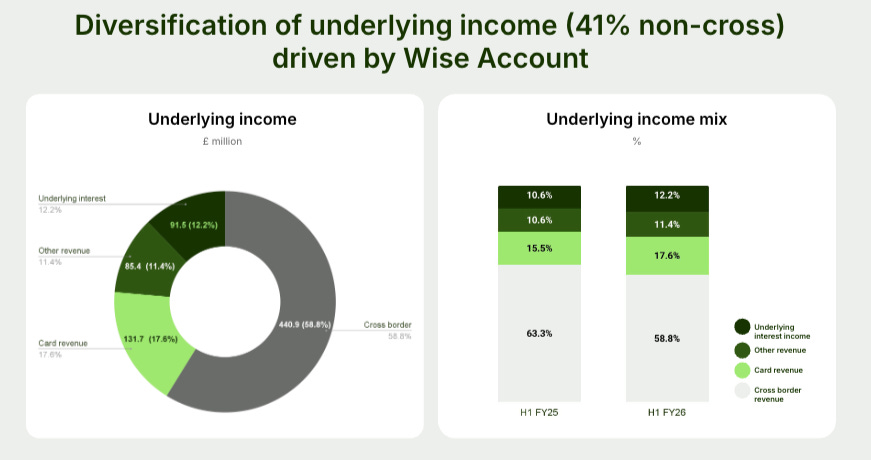
Plainly said, Wise is a cross-border payments company. However, more and more, the company is diversifying its source of income:
3. Business model and competitive advantage
The company repeats consistently that its intention is to take cross-border payments costs as near to zero as possible. This, by the way, has been a goal of the G20, which in 2020 made this issue a priority focus of the organization (sources at the end). The goal of the G20 is to take the costs of cross-border payments to less than 3%.
However, this goal is still far, since most of the transactions have a higher cost than that. Here are some examples:
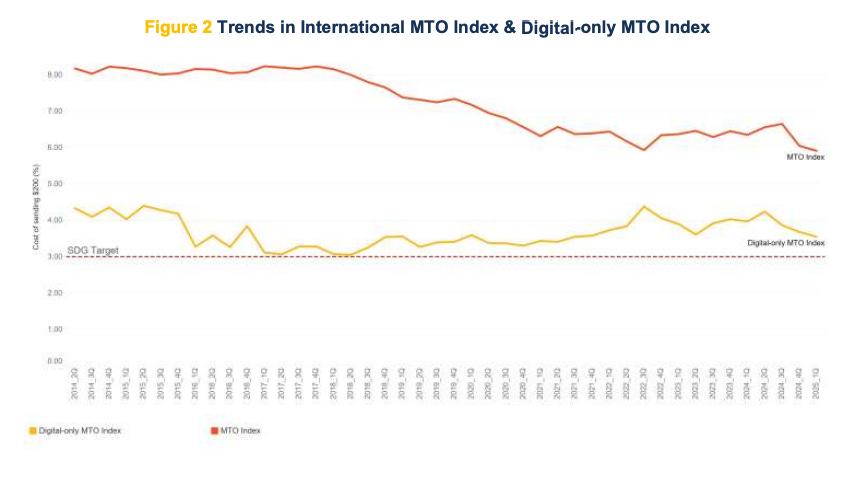
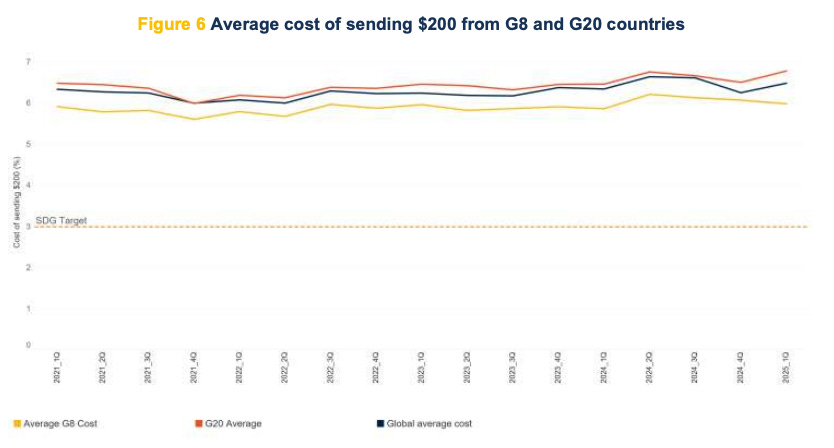
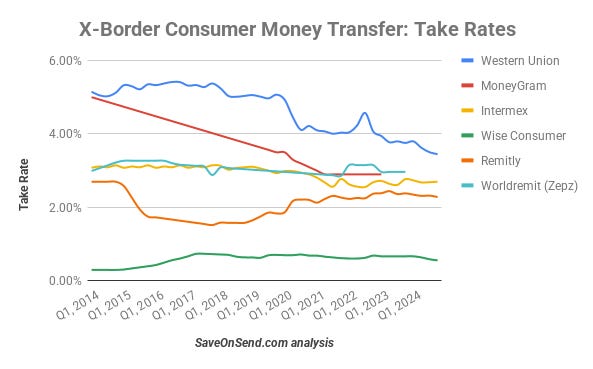
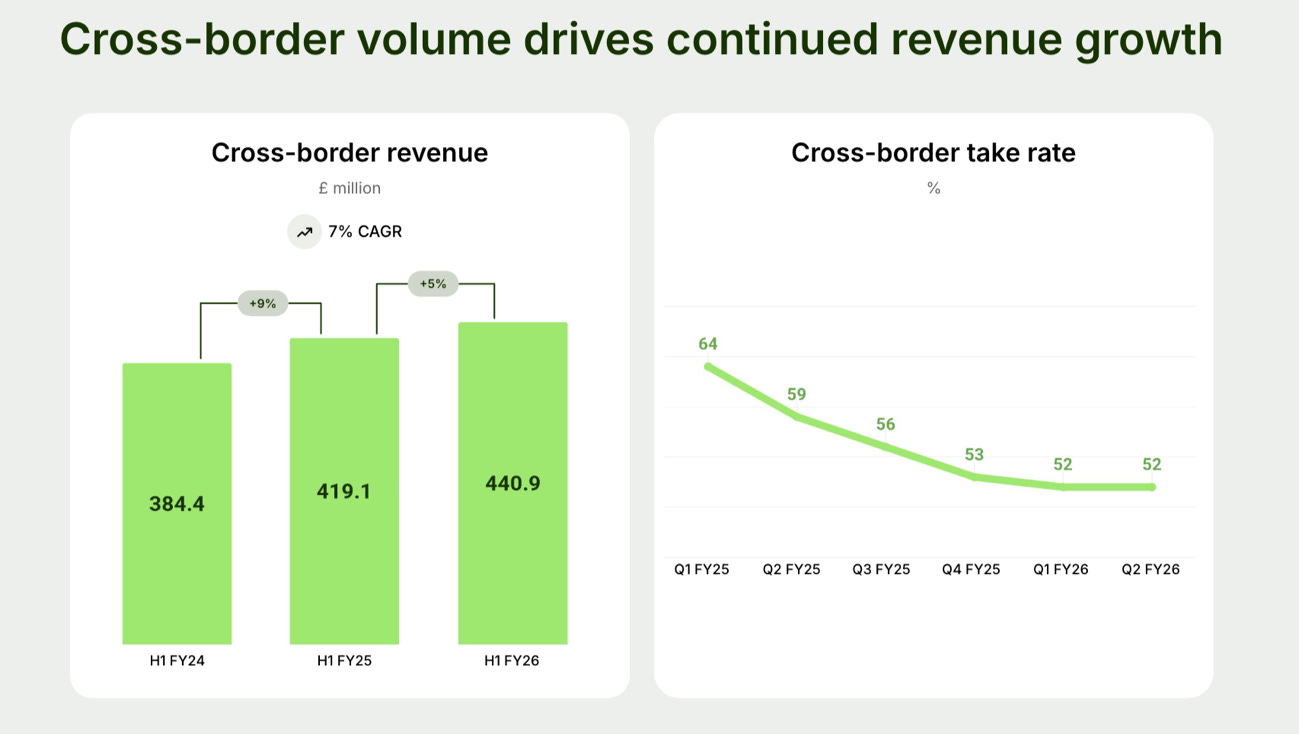
Digital providers tend to be cheaper than non-digital companies. However, WISE is the cheapest of the bunch, with its cost not only below the digital players, but also considerably below the G20 target. In particular, as of the last quarter, Wise’s take rate is 0.52%.
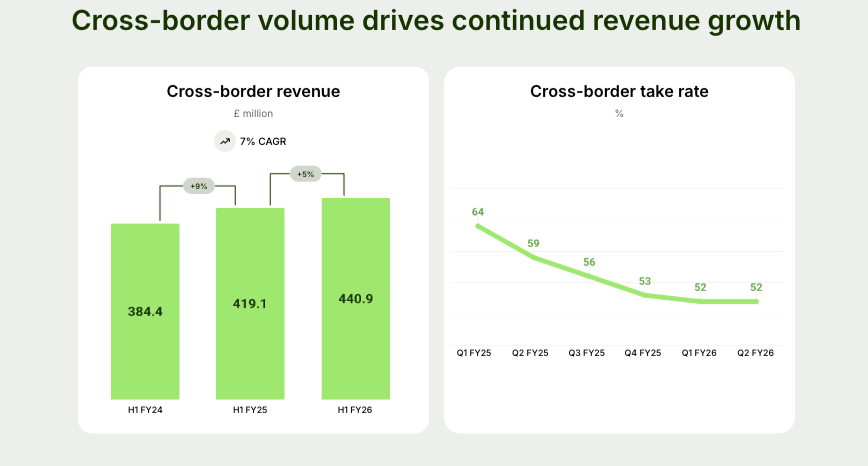
This attitude towards lower take rates has been criticized by analysts, which weight more short-term gains. In particular, the analyst complains about Wise’s management leaving shareholders money on the table. That is true, at least in the short term. However, with a well-aligned management taking care of the company’s future, I see this movement more as an investment to build the company’s moat.
To compare the company’s with one of the fastest-growing competitors, during the past two quarters, Remitly’s take rates have been 2.28% and 2.15%. Still, the company is unable to make money. No wonder that Wise’s cross border volumes have surpassed all competitors, including the legacy business Western Union.
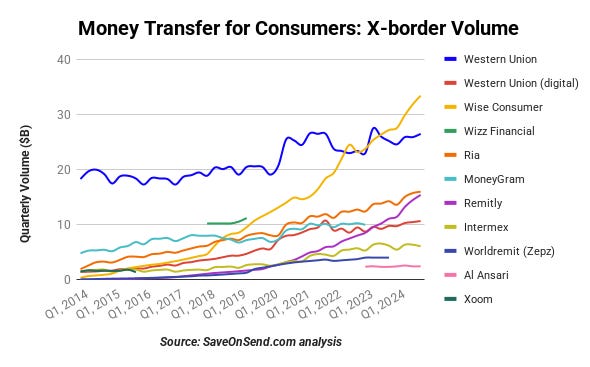
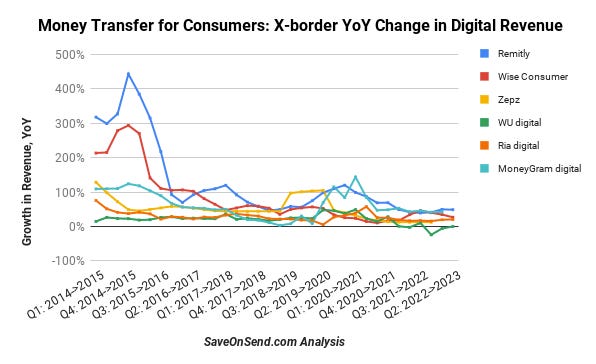
Regarding the industry as a whole, cross-border transfers have grown less than 10%, which means that the current growth of Wise and Remitly (about 20%) is very healthy and makes them gain market share. The difference? Wise makes money, Remitly struggles.
A competitive space?
Cross-border payments has been a very competitive industry. Big banks have a good part of the pie, although they are considerably more expensive for the consumer. Hence, the market has been flooded with new competitors since Wise (TransferWise back then) was launched.
One competitor that’s important is Revolut. Revolut has a very competitive price for cross-border payments, but it is a part of the business that loses money for them. Instead of making money with remittances, they aim (and achieve) profitability by charging for other features. This is what the consensus looks like in the industry: cross-border payments are going to be close to free, and profits will be made by different services.
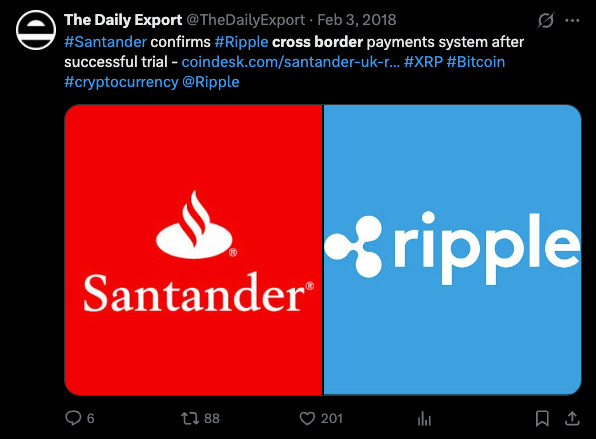
Also, besides Revolut, many new competitors entered the market. One example is PagoFX, by Santander bank. At the beginning, it was announced to be a payment system using Ripple (yes, the cryptocurrency), but Santander ended up not using Ripple and closing the service soon after.
Another examples is HSBC’s Zing, launched in early 2024 with a cost of 0.2% per money transfer. Zing was, of course, shut down only a year after its launch. A similar experience had BBVA with Tuyyo.
So yes, this is a competitive field, but Wise is doing a great job by being the lower-cost provider AND the only consistent profitable company.
Back to the company:
Back to the company’s numbers, Wise makes money out of four main segments: cross-border fees (58.8% of the revenue), card revenue (17.6%), underlying interest (12.2%), and other revenue (11.4%).
Cross border-revenue grew at 5% during the latest quarter, but cross-border volumes went up by 26% constant currency (24% non-constant). Hence, the lower take rates are taking a dent at the company’s growth, but it is bringing a healthy growth. There’s nothing like sharing the benefits of your business model with your clients to make a great moat.
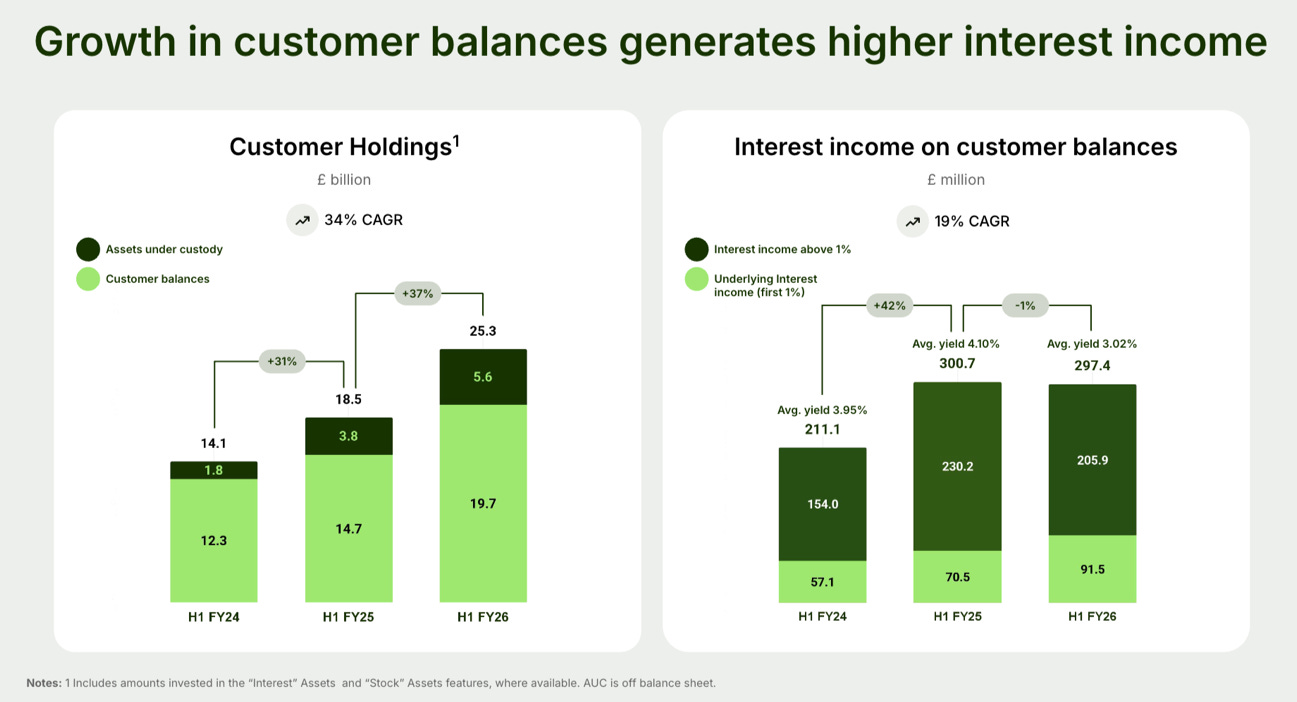
Card revenue grew by 28% in the first half of their full year 2026, slowing down from 38% the prior year. And then, more interestingly, the interest income on customers balances stayed flat, despite the lower interest rates, mainly due to a 37% increase in customers holdings.
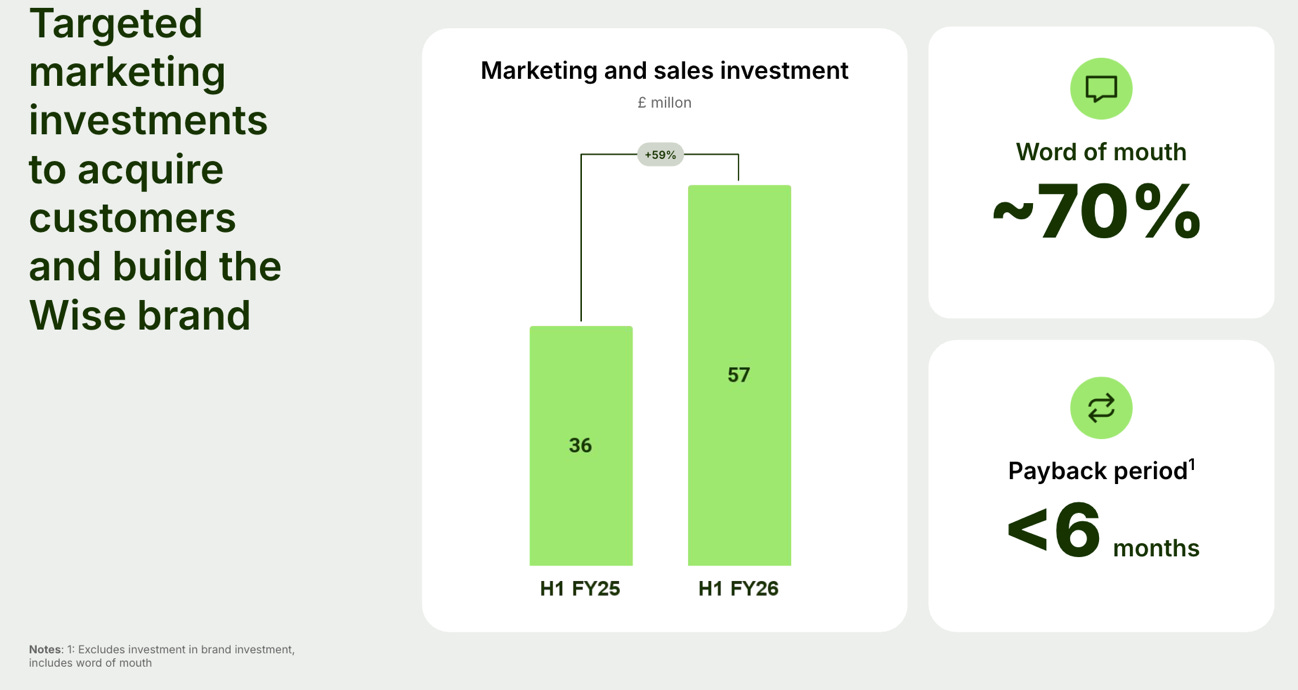
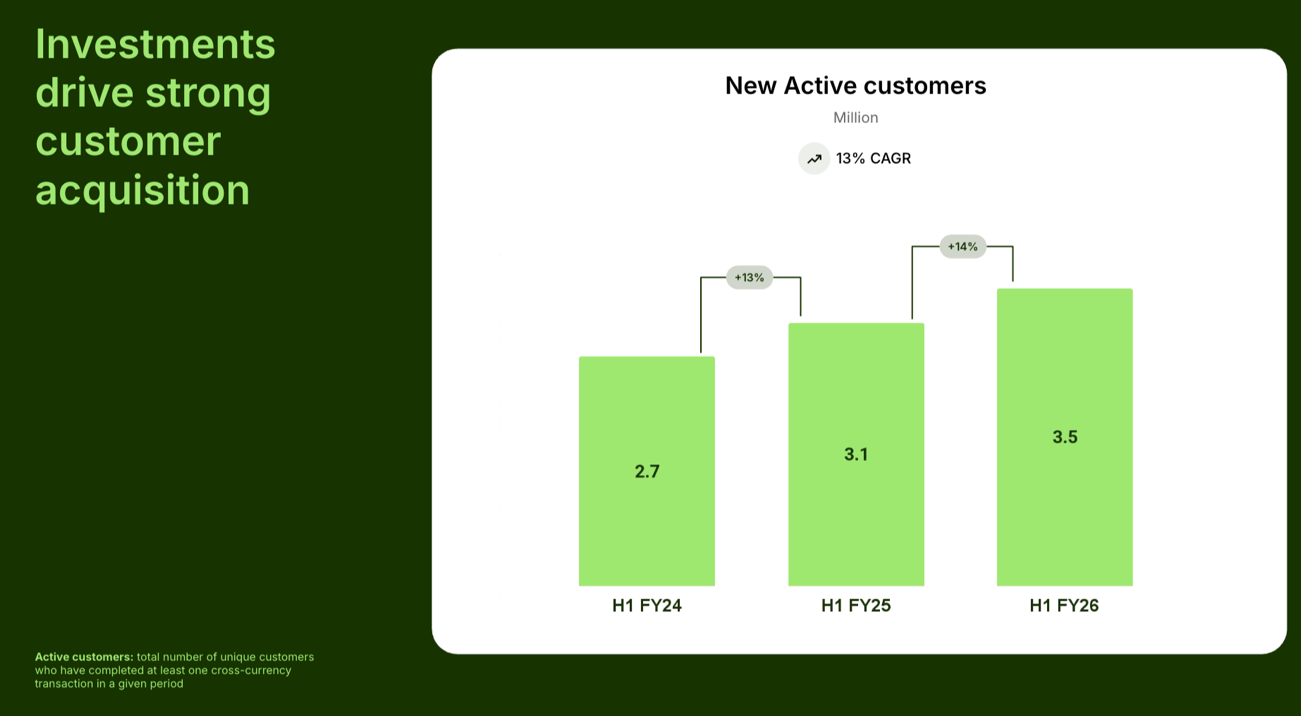
Being the lowest cost operator in the industry is very important and gives Wise an essential competitive advantage: their customers mainly come from word of mouth (about 70% of them). Hence, without spending as much as competitors like Remitly, they can match its competitor’s users growth. Despite this, the company is now entering a phase of higher marketing expenses to acquire more customers. Wise also indicates that the payback period is of less than 6 months.
The hidden gem:
All of this said, the hidden gem of Wise is not only how good, cheap, and fast they are (74% of their payments are instant, compared with 31% in 2021, way ahead of competition). Also, many banks and big players in the industry are using WISE Platform as their way to send money. Basically, these banks, like Morgan Stanley or Standard Chartered, use Wise’s service and then charge a fee on top of that to their clients. This way, their clients have a lower cost in their transactions, and they don’t have to build the network to provide this low-cost service, nor lose money like Revolut does.
The moat:
I will borrow my own words:
“Wise is building a durable and strong moat by eliminating intermediaries in international money transfers. This allows the company to charge less to its customers while making much more money than its competitors. Also, by reducing the number of banks that the money goes through, they’ve reduced the bureaucracy that needs to be filled out, and then, most of Wise’s transfers are immediate.”
How does Wise work?
So at this point, we know that Wise does the same as its competitors, at a fraction of the cost, and make money of it. How, if everyone else is losing money? The answer is simple, but not easy, as Charlie used to say.
Wise has built an entire network worldwide, connecting directly to local payments systems. This way, they get rid of the intermediary banks that are usually involved in international transfers, making the process cheaper and faster.
To understand this, we need to clarify how these international transfer are usually made. And here’s the graphic:
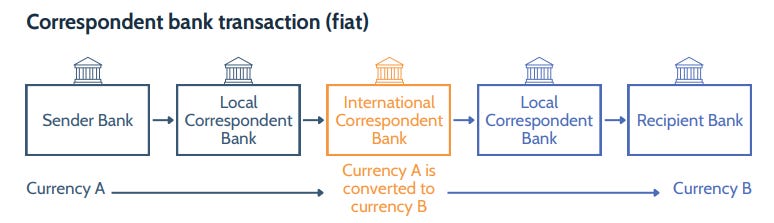
Wise has basically removed every step of this transaction, leaving only the international recipient bank in the equation (unless they send to a WISE account, in which case all the transaction is made by WISE). How? Connecting directly to the local payment systems, and then making national transfer instead of international, using pre-funded accounts (the famous Nostro-Vostro accounts). No money is actually send internationally, unless there are insufficient funds in a given country after netting all money transfers from country A to B and from country B to A.
This way, they can charge much less, make it way faster, and, if they keep growing, the cost of having operational cash in the pre-funded accounts, can be divided by a larger amount of transactions. It’s genius, and the result of many years of hard work by the management of the company.
The elephant in the room: Stablecoins disruption?
Stablecoin companies claim that they can make international money transfer for as low as 1 cent per transaction. That may be true, but only to a part of the whole process. Let me share the so called “stablecoin sandwhich”:
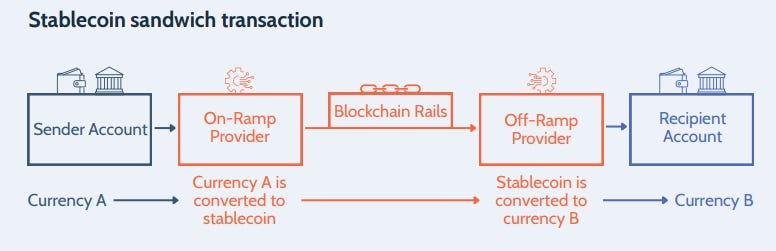
This is how the process work with stablecoins. You send the money to a on-ramp provider, which exchanges your fiat currency to stablecoins, then use the blockchain to send it to another provider, the off-ramp, which changes it back to a different fiat currency. The part in orange, which is the international transfer, is almost free. But the issue is how much the on-ramp and off-ramp costs. That is, how much converting money from fiat to crypto and from crypto to fiat costs. So let’s see some examples:
“Using Coinbase Commerce, the advertised 1% conversion fee equals $1,000. The typical spread of approximately 1.2% adds another $1,200. The wire transfer costs $25. The total cost reaches $2,225, representing an effective rate of 2.23% — more than double the advertised fee.
Kraken Pro presents a different picture. The 0.26% conversion fee costs $260. Using limit orders to minimize spread costs, you might incur only 0.2% or $200. The wire transfer adds $5. Total cost: $465, or an effective rate of 0.47%. This is nearly five times cheaper than Coinbase for the same transaction.
Binance charges a 0.1% conversion fee amounting to $100. The estimated spread of 0.4% costs $400. Wire transfer fees add $15. Total cost comes to $515, or 0.52% — competitive with Kraken despite the higher spread.
For businesses processing large volumes, OTC desks offer the best rates. With conversion fees typically between 0.1–0.3% (around $200), spreads of just 0.05–0.15% (approximately $100), and standard wire fees of $25, the total cost might be only $325, or 0.33% of the transaction value.
For international transfers, these costs multiply dramatically. Adding foreign exchange conversion and correspondent banking fees can introduce another 1–3% in charges, potentially bringing total costs to 3–5% for less efficient platforms. That $100,000 conversion might yield only $95,000 in your account — a $5,000 loss that many businesses attribute to “exchange rate fluctuations” without realizing they’re paying excessive fees.”
Source: Stablegate ( https://medium.com/@stablegatecom/hidden-fees-in-crypto-off-ramps-in-2025-d6264bc60e93 )
So yes, basically the fees are low in the “international” money transfer, but the current companies in the stablecoin sector charge hidden fees in the on-ramp and off-ramp process. After all, everyone wants to make a profit, who can blame them? But so much talking to then act as the incumbents they want to break down.
4. Management and shareholder
As I’ve stated before, the founder, CEO, and owner of 18% of the business is still running it. And he’s done an amazing job creating what I consider to be a wide moat in a very competitive industry, making big players like Santander, HSBC, and many fintech close their operations.
It’s true that the voting to maintain his privileged voting powers should be part of a separate discussion, and not joint with the US listing, but honestly, I would rather have Kristo running the business for 10 more years, with a focus on long-term value creation, than having a Wall Street person raising take rates to make a quick buck.
So yes, Kristo is an essential part of the investment thesis, as Jeff Bezos used to be for Amazon.
5. Valuation
All the above helps create the narrative. However, now it is time to put numbers in the picture. The market perceives a lot of uncertainty because of the competitive nature of the industry and the potential disruption of stablecoins. But the data shows something different: Wise is the lowest-cost provider and even stablecoins competitors can match what they do. Hence, even if growing in cross-border payments will probably slow down, it is unstoppable that being the cheapest provider gives you market share.
Hence, in my pessimistic scenario, I project 15% revenue growth, with 13% underlying profit (the company aims for 16%), and 10% growth in income beyond 1%. With a PE ratio of 20 times earnings in 2030, the internal rate of return would be 5% from the current price.
However, if the company can grow in line with its volume growth, which is about 20% per year, they achieve a 16% underlying profit, and interest rates stay flat and they can achieve a growth in interest earned beyond 1% because customers holdings keep increasing, with a terminal multiple in 2030 of 30 times earnings, the IRR would be over 24% (200% cumulative return).
I personally consider the latter a more plausible scenario, since the company is signaling that they are done with take rates cuts (because they have already reached the 16% underlying profit). Therefore, cross-border volumes growth and revenue growth should match moving forward, and with a higher budget of marketing, both customers’ holdings and volumes should go up.
Furthermore, the company keeps reaching agreements with banks to be their “white label” product in cross border payments, which increases volumes considerably, too.
6. Catalysts and risk factors
· Catalysts
Sustained growth
Agreement with more Banks to use Wise’s platform.
US listing.
End of take rates cuts.
New products, like has happened in the past with Wise’s card. New sources of income may increase the appeal of Wise exponentially.
· Risk factors
Competitive wars, lowering prices (short-term)
Stablecoins being a cheaper alternative to Wise’s network
8. Investment thesis
The industry in which Wise operates is highly competitive. However, Wise has been a player that has disrupted major incumbent players while being very profitable. The “war” that has taken down Wise’s revenue growth and profitability, has been self inflicted to gain market share and build a moat. Hence, once no one else can compete due to the low prices, every major player would be better off making Wise’s platform the default option for everyone to send money abroad. Why build another network, which is expensive, if you already have a cheap one?
There’s a real risk, though, with stablecoins. However, the on-ramp and off-ramp costs are very high. In the end, even crypto businesses need to face their costs. Also, despite regulation playing catching up in the crypto space, it will come. And that may pose an extra burden in stablecoins’ businesses, making their remittances more expensive.
After all, what people want are cheaper, faster, and safer money transfers. And to do that, Wise is the best option.
PS: The analysis leaves aside some optionality of Wise become a neobank, which may be a rational step after growing its customer base and its customers holdings. This may collide, though, with some of its partners, like Nu bank.
Disclaimer
This post is written by Cristià Calle, known as CCalle on eToro. Miguel Maeztu, known as AzeriaInvest is part of CM Capital Research. You can find us here:
Cristia Calle Mercado - eToro Popular Investor | https://etoro.tw/4lPaH5z
Miguel Maeztu - eToro Popular Investor | https://etoro.tw/3JGPmxS
Copy Trading is not investment advice | Capital at risk | Past performance does not guarantee future results.
Informational only: This analysis is for information/education and is not investment, legal, accounting, or tax advice, nor a recommendation to buy or sell any security. CM Capital Research is not acting as an advisor or fiduciary.
Risks: Investing involves risk, including loss of principal. Past performance does not guarantee future results. Any forward‑looking statements are uncertain and may change without notice.
Accuracy: Information may be incomplete or inaccurate. No warranty is made regarding timeliness or completeness.
Conflicts: The Author(s) and affiliates may hold, buy, or sell the securities mentioned without notice.
No offer: This is not an offer or solicitation in any jurisdiction where it would be unlawful. Consult a qualified professional for personalized advice.
NOTES:
*The two founders collided recently, in a recent shareholder vote. The company, lead by Kristo, proposed the US listing and the extension of his privileged voting rights, which was approved. Taavet was against this initiative, since he was defending that the two initiatives should be subject of two different votes. Anyway, the initiatives were approved by shareholders, so Wise’s primary listing will be moved to the US, and Kristo will retain his supervoting powers for 10 more years.
Sources:
Voting US listing and Supervoting rights: https://www.bankingdive.com/news/wise-shareholder-vote-listing-new-york-london-golden-share-kaarmann-hinrikus/756280/
G20 about cross-border payments: https://www.fsb.org/uploads/P091025-1.pdf
G20 about cross-border payments 2: https://corporates.db.com/files/documents/publications/DB-G20-Roapmap-WP-40pp-Web-Secured.pdf
Worldbank file: https://remittanceprices.worldbank.org/sites/default/files/rpw_main_report_and_annex_q125_1_0.pdf
Saveonsend data: https://www.saveonsend.com/money-transfer-startups/
FXC Intelligence: https://www.fxcintel.com/research/analysis/stablecoin-incentives-explainer
Stablegate: https://medium.com/@stablegatecom/hidden-fees-in-crypto-off-ramps-in-2025-d6264bc60e93
Some other good analysis: https://substack.com/@moneyflowinvesting/p-146043711
Some other good analysis 2:

Some other good analysis 3:

Some other good analysis 4: https://substack.com/@ccalle/p-168614698
Great analysis!!! Wise is also one of my main positions. I’m curious about the last point you made regarding the optionality of Wise becoming a bank. To me, that scenario represents more of a risk. Right now, their business model is excellent: capital-light and highly efficient. Becoming a bank would not only increase tensions with their partners but would also add leverage risk and significantly more regulatory scrutiny.